
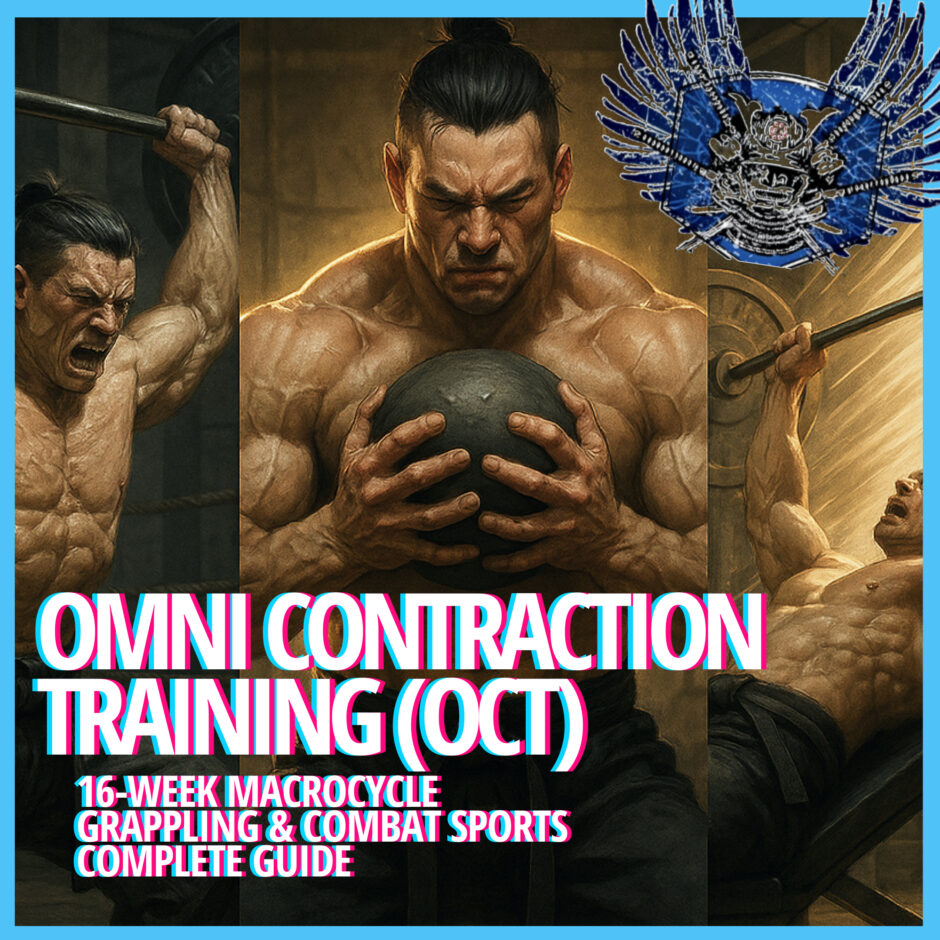
Strength training for combat sports cannot be a copy-paste of bodybuilding or generic weight room routines. Grappling, striking, and MMA demand that the athlete can absorb force, hold position, and then explode into movement under chaotic and unpredictable circumstances. This is exactly what the Omni Contraction Training (OCT) system was designed for. By training eccentric, isometric, and concentric contractions in a structured way, athletes prepare their muscles, tendons, and nervous system for the real demands of combat.
The Three Contraction Types and Their Relevance
The eccentric phase—muscles lengthening under tension—is about controlling and absorbing force. Think of sprawling against a shot, resisting a sweep, or maintaining posture under heavy pressure. Science shows eccentric-only training produces superior gains in eccentric strength compared to concentric work alone, while also strengthening connective tissue and reducing injury risk.
Isometric strength is the ability to produce high tension without moving. Grappling is filled with isometric demands: clamping a guard, posting an arm to frame, squeezing an opponent’s torso, or fighting for wrist control. This form of strength improves joint angle–specific force and teaches the body to lock down positions. Charles Poliquin used to emphasize that most combat sports were largely isometric by nature, making this contraction type indispensable.
Concentric contractions—the shortening of the muscle—are where explosive action happens. This is the double-leg takedown drive, the bridge out of bottom position, or the sudden reversal into a sweep. Concentric training builds rate of force development, teaching athletes to go from static to dynamic in an instant.
Combat does not occur in neat categories; athletes constantly shift between absorbing, holding, and exploding. OCT ensures training reflects this reality rather than ignoring it.
Structuring OCT (Preview)
There are two main models of application. The first, which Charles Poliquin often used, is to integrate all three contractions in a single workout. For example, an athlete might perform slow eccentric chin-ups, follow with isometric holds at 90°, and finish with explosive concentric pull-ups. This method is efficient and ensures all qualities are trained, which is ideal when mat time limits the number of strength sessions per week.
The second approach, borrowed from Eastern Bloc methodologies, is to separate the contraction types into dedicated days. One day is devoted to eccentric overload, another to isometric holds, and a third to explosive concentric work. This allows for maximum overload and clearer progression in each category but requires more training days.
The smartest application for fighters is a hybrid: build the qualities separately in the off-season using split contraction days, then integrate them pre-season and in-season with all-in-one sessions for fight-specific readiness.
👉 This is just the preview of the full article. To read the complete breakdown—including the 12-week OCT plan, training tables, and specific workouts for grapplers—check out the full version inside my Bodhifit App. There, you’ll get:
- Complete Phase 1 and Phase 2 training splits
- Detailed set/rep schemes for eccentric, isometric, and concentric work
- Conditioning protocols to match the OCT system
- A fully periodized plan designed specifically for fighters
Download the Bodhifit App now and unlock the entire program.
Whether you’re a seasoned athlete or just beginning your fitness journey, our app offers tailored programs designed by experts from all walks of life. From comprehensive Brazilian Jiu-Jitsu training regimens to a wide range of fitness goals, BodhiFit has you covered. Join our community and embark on a journey of self-improvement today.
So don’t wait any longer, try the Bodhifit app today, and start seeing results right away. If you have any further questions, do not hesitate to contact us. We are available to assist you anytime.
Come on and join our team now!


Leave a reply
You must be logged in to post a comment.